
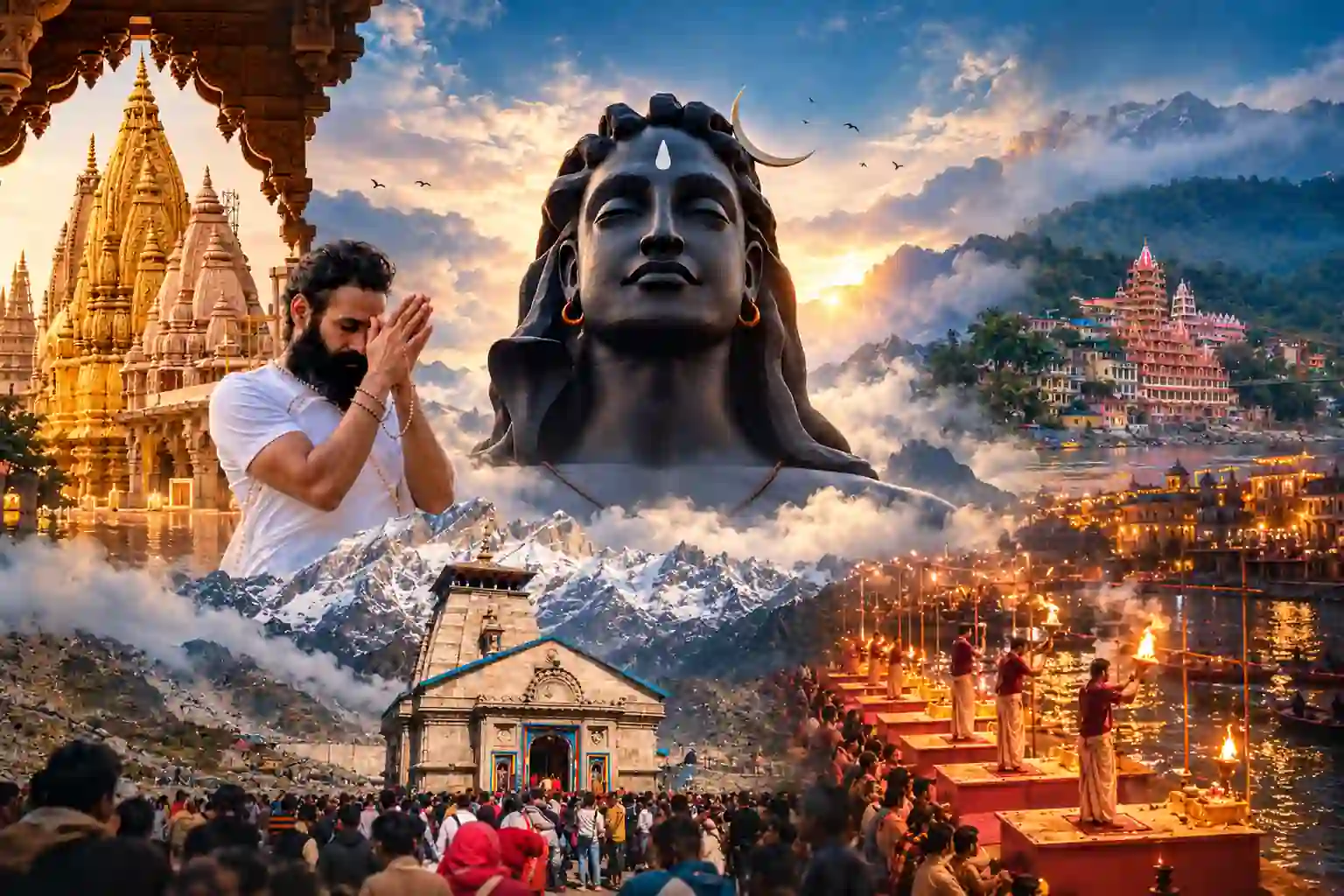
India’s most transformative sacred circuits are the Himalayan Char Dham Yatra, Kashi–Prayagraj–Ayodhya, the Buddhist Circuit, Rishikesh–Haridwar, Puri–Konark, Rameswaram–Madurai, Somnath–Dwarka and Amritsar. Most are best visited from October to March, while the Himalayan Char Dham is open from about late April to early November.
What Is a Sacred Circuit in India?
A sacred circuit in India is a connected route of holy sites, such as temples, ghats, monasteries and gurdwaras, that travelers visit in sequence. Many follow traditions that are centuries old, and each one asks something different of you: a mountain trek, a quiet river aarti, a day of silence. You do not need to be religious to feel it. Many travelers go simply to slow down, ask bigger questions and see India beyond the checklist. Here are eight circuits worth planning around.
Char Dham Yatra, Uttarakhand: The Himalayan Pilgrimage of a Lifetime
The Char Dham Yatra links four Himalayan shrines in Uttarakhand: Yamunotri, Gangotri, Kedarnath and Badrinath. The traditional route runs in that order, and Kedarnath needs a trek of roughly 16 km from Gaurikund, or a helicopter ride. The thin air and the effort are part of the experience. Best time to visit: May to June and September to October. Ideal duration: 10 to 12 days. Good to know: the temples open around Akshaya Tritiya and close around Bhai Dooj, and free online registration is mandatory, so register on the official Uttarakhand portal first.
Kashi, Prayagraj and Ayodhya: The Ganga Plains Pilgrimage
This route connects Kashi (Varanasi), home to the Kashi Vishwanath Temple and the evening Ganga Aarti, with the Triveni Sangam at Prayagraj, where the Ganga and Yamuna meet, and Ayodhya, where the Ram Mandir was consecrated in January 2024. It is the most accessible circuit for first-time pilgrims. Best time to visit: October to March. Ideal duration: 4 to 5 days. Good to know: book stays well ahead around festivals and the Magh Mela season in Prayagraj.
The Buddhist Circuit: Bodh Gaya, Sarnath and Kushinagar
Follow the Buddha’s life from enlightenment under the Bodhi tree at Bodh Gaya, to his first sermon at Sarnath, to his final rest at Kushinagar. Lumbini, his birthplace, is just across the border in Nepal. The monasteries here are calm, and silence is easy to find. Best time to visit: October to March. Ideal duration: 7 to 10 days. Good to know: Bodh Gaya’s Mahabodhi Temple is a UNESCO World Heritage Site, and modest dress is expected.
Rishikesh and Haridwar: Ganga Aarti, Yoga and Meditation
Haridwar’s Har Ki Pauri Ganga Aarti at dusk is one of India’s most moving rituals. Just upstream, Rishikesh is known as the yoga capital of the world, with ashrams, riverside meditation and morning classes. Best time to visit: September to November and February to May. Ideal duration: 3 to 4 days. Good to know: both towns are largely vegetarian and alcohol-free, and ashram stays are best booked ahead.
Puri, Konark and Bhubaneswar: Odisha’s Temple Triangle
Puri’s Jagannath Temple draws millions during the Rath Yatra each June or July. Nearby, the 13th-century Konark Sun Temple is a UNESCO World Heritage Site, and Bhubaneswar is full of ancient temples. Best time to visit: October to March. Ideal duration: 4 to 5 days. Good to know: entry to the Jagannath Temple is restricted to Hindus.
Rameswaram and Madurai: Temple Towns of Tamil Nadu
Rameswaram’s Ramanathaswamy Temple is both a Jyotirlinga and one of the four Char Dham, known for its long pillared corridors and 22 holy wells. Madurai’s Meenakshi Amman Temple, a few hours away, is a riot of color and ritual. Best time to visit: October to March. Ideal duration: 4 to 5 days. Good to know: check temple timings and dress codes in advance.
Somnath and Dwarka: Gujarat’s Coastal Pilgrimage
Somnath is regarded as the first of the twelve Jyotirlingas, and Dwarka’s Dwarkadhish Temple is one of the four Char Dham. Both sit on the Arabian Sea, and the evening aarti at Somnath is a highlight. Best time to visit: October to February. Ideal duration: 4 to 5 days. Good to know: the two towns are a long day’s drive apart, so plan the transfer.
Amritsar: The Golden Temple and Sikh Heritage
Harmandir Sahib, the Golden Temple, welcomes people of every faith. Its community kitchen serves free vegetarian meals to thousands of visitors every day. Sit by the sarovar at dawn, then visit nearby Jallianwala Bagh. Best time to visit: October to March. Ideal duration: 2 to 3 days. Good to know: cover your head, remove your shoes and avoid tobacco and alcohol within the complex.
Which Sacred Circuit Is Right for You?
For a first pilgrimage, start with Kashi, Prayagraj and Ayodhya. For a physical challenge, choose the Char Dham Yatra. For peace and meditation, pick the Buddhist Circuit or Rishikesh. For temple architecture and culture, go to Odisha or Tamil Nadu. For a short, welcoming spiritual break, spend two days in Amritsar.
How to Plan a Spiritual Journey in India
Dress modestly, carry cash and book stays early around festivals. Pace yourself, because pilgrimage days are long, and altitude, crowds and heat all take energy. Hire a local guide for context. Rules, registrations and road conditions change, so confirm them just before you travel. Archu Travels, a Varanasi-based travel company, plans Kashi–Ayodhya, Char Dham and Buddhist Circuit journeys. Send us an enquiry with your dates and we will help you build the route.
Frequently Asked Questions
Continue Reading


Need help planning this trip?
Tell us your dates, destination and preferences. We'll help you figure out permits, timing and the honest steps in between.
Ask on WhatsApp