
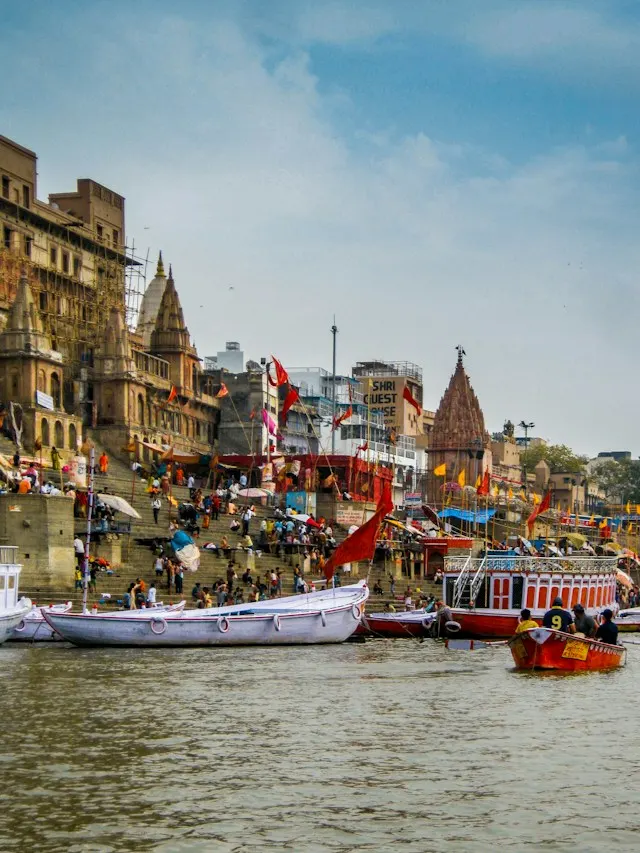
The top 14 places to visit in Varanasi, in route order, are Assi Ghat, Gauri Kedareshwar Temple, the Nepali Temple, Manikarnika Ghat, Kashi Vishwanath Temple, Kaal Bhairav Temple and Dashashwamedh Ghat on day one, then Namo Ghat, Sarnath, Bharat Mata Mandir, the New Vishwanath Temple at BHU, Ramnagar Fort, Durga Kund with Tulsi Manas Mandir and Sankat Mochan Temple on day two. Two days is enough to see them all, with day one on the river and old city and day two on the outer sites. In winter, go early for sunrise and darshan, and reach Dashashwamedh by 5 PM for a good view of the evening aarti.
Why is Varanasi the city every traveller must see once?
It is a little past five in the morning. The air smells of wood smoke, marigolds and wet stone, and somewhere above the river a temple bell has started a conversation with a conch shell. On the ghat steps, a man in a woollen shawl lets Ganga water run through his hands. A boatman wipes the dew off his oars. Nobody is in a hurry, and yet the whole city seems to be moving.
That is Varanasi, and it is hard to describe because it does not behave like a tourist destination. It behaves like a living ritual. People have been coming to Kashi for more than two thousand years, and they still come for the same reasons: to bathe in the Ganga, to bow before Shiva, to listen, to eat, to sit still for a while. For a first-time visitor, the trouble is rarely finding things to see. It is knowing where to begin and in what order, so that your days feel like a story instead of a scramble.
This guide is built to fix exactly that. These are the fourteen places that give you the real Kashi, including a quiet ghat temple where Kedarnath is said to come to Kashi. They are numbered in the order you will reach them, so nearby places come one after another. You will find the best time of day for each, practical tips for the cooler months (October to March is when Varanasi is at its kindest), and a simple plan to fit them all into two comfortable days. And there is a fresh reason to come this year: on 25 July 2026, UNESCO inscribed Sarnath, just outside the city, on the World Heritage List, India’s 45th World Heritage Site.
What are the top 14 places to visit in Varanasi, in route order?
The top 14 places to visit in Varanasi are listed here in the order you would naturally reach them. Day one follows the river and the old city from south to north: Assi Ghat with Subah-e-Banaras, Gauri Kedareshwar Temple at Kedar Ghat, the Nepali Temple at Lalita Ghat, Manikarnika Ghat, Kashi Vishwanath Temple with Annapurna Devi, Kaal Bhairav Temple, and Dashashwamedh Ghat for the evening Ganga aarti.
Day two covers the outer circle: Namo Ghat at the northern end of the ghats, Sarnath, Bharat Mata Mandir, the New Vishwanath Temple at BHU, Ramnagar Fort across the river, and then Durga Kund with Tulsi Manas Mandir and Sankat Mochan Hanuman Temple in south Varanasi, a short ride from where your trip began at Assi.
How many days do you need to see the top 14 places in Varanasi?
Two days is the comfortable answer, and one very full day is the minimum if you choose carefully. The reason is geography. Varanasi’s best sights sit in several different corners. The old city and its ghats, home to Kashi Vishwanath, Kedar Ghat, Lalita Ghat, Manikarnika, Dashashwamedh and Kaal Bhairav, are close together but too narrow for vehicles, so you walk or take a boat. Namo Ghat sits at the northern end of the ghats, near Rajghat. Sarnath lies about 10 km to the north-east, and Bharat Mata Mandir stands close to Varanasi Junction railway station. South Varanasi, with Assi Ghat, Durga Kund, Tulsi Manas, Sankat Mochan and the BHU campus, is several kilometres from the old city. And Ramnagar Fort sits across the river, around 14 km from the city centre by road.
If you only have one day, our short list is Assi Ghat at sunrise, Kashi Vishwanath in the late morning, and the Ganga aarti at Dashashwamedh at dusk, with Sarnath added if you start early and have a vehicle waiting. Everything else can wait for your next visit, and trust us, there will be one.
Assi Ghat and Subah-e-Banaras: Sunrise the Way Locals Do It
The first sun in Varanasi belongs to Assi Ghat, the southernmost of the main ghats, where the small Assi stream meets the Ganga. Long before sunrise, people gather on its wide steps for Subah-e-Banaras, which means “the morning of Banaras”. It is a free daily programme that begins about 45 minutes before sunrise and runs for nearly two hours. It opens with a Ganga aarti and Vedic chanting, flows into live classical music from Banaras’s own musical families, and ends with open-air yoga as the sky turns gold.
Best time: in winter the programme starts between about 5:30 and 6:15 AM depending on the month, since it follows sunrise, so reach Assi about fifteen minutes early and find a step. It is cold at that hour, so layer up, and keep a few coins for a kulhad of hot chai from the stalls.
Many visitors follow the programme with a sunrise boat ride from Assi toward Dashashwamedh and Manikarnika, the best way to see the long, curving line of ghats in soft light. Along the way the boat passes Tulsi Ghat, Chet Singh Ghat with its old fort, and Harishchandra Ghat, the city’s second cremation ghat. Agree the fare, route and duration with the boatman before you board, and book through a trusted operator in peak season. Winter fog may hide the far bank, but it gives the river a dreamlike calm.
Later in the day, Assi turns into a relaxed, youthful hangout with cafés along the steps, a good place for lunch. Next stop: stay on the boat for a short ride north to Kedar Ghat.
Gauri Kedareshwar Temple: Kedarnath, Brought to Kashi
Each year, around Bhai Dooj in November, the doors of Kedarnath, the Himalayan jyotirlinga standing more than 3,500 metres up in Uttarakhand, close for the winter snow, and the deity is carried down to Ukhimath to spend the cold months in a lower temple. Kashi has its own answer for everyone who cannot make that journey. On the steps of Kedar Ghat, in the south of the old city, stands a temple that Varanasi has long called its Kedarnath: Gauri Kedareshwar.
How did Kedar come to Kashi? The Kashi Khanda of the Skanda Purana tells of the sage Vashishtha, who used to travel to the Himalayas to worship Kedareshwar. When he could no longer make the long journey, he asked Shiva to appear in Kashi itself, and Shiva did, promising that worship here would bring seven times the merit of worship at the Himalayan shrine. Local tradition tells the story with another sage, Mandhata, who worshipped Shiva at Kedarnath until Shiva appeared in his dream and asked him to continue the worship in Kashi. Whichever version you hear, the message is the same: the mountain has come to the river. varanasitemples
What makes the temple special is how much it holds. Its linga is believed to be self-manifested and is worshipped as Gauri and Kedareshwar together, which is how the temple got its name. At the foot of the steps lies Gauri Kund, a small kund that tradition calls Adi Manikarnika, the “first” Manikarnika. It is mostly dry and fills mainly in the monsoon. Kashi is said to rest on the trident of Shiva, and Kedareshwar marks the boundary of Kedar Khand, one of the city’s three sacred divisions, alongside Omkar Khand and Vishweshwar Khand. The present temple, with its red-and-white striped walls and Dravidian touches, was built by the Tamil community, and the ghat is full of South Indian pilgrims, so you will often hear prayers in Tamil and other southern languages.
Best time: Mangala aarti is at about 3:15 AM, with further aartis at about 10 AM, 5:30 PM and 10:30 PM, and timings shift with the season, so confirm locally. For most visitors, the loveliest way to arrive is by boat at sunrise or just before sunset, when the ghat fills with bathers and devotees; you step off the boat and climb the steps straight into the temple. The steps are high and steep, so take your time, especially with elders. By road, Kedar Ghat is reached through the lanes of Bengali Tola, so your driver will drop you at the nearest point and you walk the rest. Allow about an hour.
The ghat is crowded on Mondays in Shravan (July to August), so winter is a calmer season to visit, and a good one for anyone who cannot be at Kedarnath itself. Next stop: board the boat again and continue north, past Dashashwamedh, to Lalita Ghat.
Nepali Temple at Lalita Ghat: A Little Nepal on the Ganga
Beside Lalita Ghat, a short walk from Manikarnika, stands a temple that looks as if it was lifted out of Kathmandu and set down on the Ganga. The Nepali Temple, also known as Kathwala, the “wooden” temple, was begun in the early 19th century by King Rana Bahadur Shah of Nepal during his exile in Varanasi. He wanted a replica of Pashupatinath, and his son completed the temple along with the ghat and a dharamshala. Its intricate wood carvings and distinctly Nepali style make it a rare piece of Nepali architecture in the heart of India.
Best time: the temple is generally open from about 4 AM to 9 PM, and 30 to 45 minutes is enough to take in the carvings. Morning light from the river warms the wood, and it is a gentle first stop after your boat ride. Lalita Ghat also has the Lalita Gauri shrine. Dress modestly, and ask before photographing inside, as this is an active place of worship. Next stop: a short walk along the ghat brings you to Manikarnika.
Manikarnika Ghat: Seeing Kashi’s Eternal Fire From the River
Manikarnika is the most solemn place in Varanasi and one of the most important. It is the city’s main cremation ghat, where Hindus believe that a soul who departs in Kashi is granted moksha, liberation from the cycle of birth and death. Pyres burn here day and night. For the families who come, and for those who work here, it is not a spectacle but a quiet, dignified acceptance of the end of life. Beside the ghat, the Ratneshwar Mahadev temple leans toward the river, one of the city’s most photographed shrines.
Best time: the ghat is open at all hours, but most visitors see it from a boat during a sunrise ride, which allows a respectful distance. If you walk through, go with a guide, stay quiet and follow instructions. Please do not photograph the cremations or the mourners. Be wary of anyone who says you must pay a “donation” for wood or a fee to watch; a polite no is enough. At sunrise, the smoke rising against the pale sky is one of the most powerful sights of the whole trip. Next stop: from here the road to Kashi Vishwanath is a short walk away.
Kashi Vishwanath Temple: Where Every Kashi Journey Begins
Ask any local where Kashi begins and you will hear one word: Vishwanath. The temple is one of the twelve Jyotirlingas of Shiva, and tradition says that a single darshan here carries the merit of visiting all twelve. Not long ago you reached it through a maze of lanes. Today the Kashi Vishwanath Corridor, opened in 2021, leads you in one broad, clean sweep from the river to the temple gate, with the Ganga behind you and the golden spire ahead.
Best time: as early as you can manage. The temple opens in the small hours, with Mangala aarti at around 3 to 4 AM, and general darshan continues until about 11 PM. But the queue is shortest at dawn and keeps growing through the late morning. If the line looks long, the temple trust’s paid Sugam Darshan, booked through its official portal, shortens the wait, though it is not available during aarti times. Check the portal for current rates and slots.
Phones, cameras and bags are not allowed inside, and free lockers are available near the entrance, so travel light. Dress modestly with shoulders and knees covered; the stricter traditional dress code applies to Sparsh Darshan, where devotees touch the lingam. The Annapurna Devi temple stands barely a hundred metres away in the same lane, and it deserves a visit. Vehicles cannot go near the temple, so your cab will drop you at the edge of the old city and you walk the rest. In winter, carry a pair of socks for the cold stone. Next stop: Kaal Bhairav, about a kilometre away.
Kaal Bhairav Temple: Asking the City’s Guardian for Permission
Locals will tell you that nobody truly settles in Kashi without the permission of its guardian, Kaal Bhairav, the fierce form of Shiva known as the Kotwal, or police chief, of the city. Many pilgrims pay their respects here before or just after Vishwanath darshan, believing the visit is incomplete without it. The temple sits in a lane of Vishweshwarganj, about a kilometre from Kashi Vishwanath, and the mood changes at the door: denser, darker, more intense. Priests tie a protective thread around your wrist as a blessing.
Best time: Sundays and Tuesdays are the special days here and draw large crowds, so go on another day for a calmer visit. The temple generally opens around 5 to 5:30 AM and closes around 10 PM, with an afternoon break of a couple of hours, so aim for the morning or early evening. Kaal Bhairav Jayanti, usually in November or December, is the biggest festival of the year, so expect heavy crowds if you travel then. Next stop: have lunch and rest through the afternoon, then walk to Dashashwamedh for the evening.
Dashashwamedh Ghat: The Evening Aarti Everyone Remembers
If Kashi Vishwanath is the heart of Varanasi, Dashashwamedh is its stage. Legend says Brahma performed ten horse sacrifices here to welcome Shiva, which is how the ghat got its name. Every evening, as the light fades, a line of young priests performs the Ganga aarti with towering brass lamps, conch shells, incense and bells, moving in perfect rhythm for about forty-five minutes. Thousands watch from the steps and from boats on the water. It is free, it is loud, and many travellers say it was the moment Varanasi finally made sense to them.
Best time: in winter the sun sets early, so the aarti begins at around 5:45 to 6 PM, and the exact time follows sunset, so allow fifteen minutes either way. The ghat is packed by about 5:15 PM, so reach it an hour early if you want a good spot. For a calmer view of much the same ceremony, try Rajendra Prasad Ghat, a minute’s walk away, or watch from a boat. Keep your phone and wallet safe in the crowd. Dashashwamedh is also lovely in the morning, when the steps fill with bathers, flower sellers and boatmen and the light falls softly on the old stone. Day one ends here. Day two heads north to the newest ghat in the city.
Namo Ghat: Varanasi’s Newest Ghat, Open to the Sky
If Dashashwamedh is the stage, Namo Ghat is the balcony. It was formerly Khidkiya Ghat, “the window ghat”, and it was officially inaugurated on 15 November 2024. It takes its name from the large folded-hands “Namaste” sculptures at its entrance. Varanasi’s first model ghat stretches about 1.5 km from Namo Ghat to Adikeshav Ghat, with an open-air theatre, a floating jetty and changing rooms. It is also the first ghat in the city designed for visitors with disabilities.
It sits at the northern end of the ghats near Rajghat and, unlike the old ghats, you can drive right up to it. Entry is free. A grand Ganga aarti has also been introduced here, which makes it a calmer alternative if Dashashwamedh feels too crowded.
Best time: sunrise, when the open steps catch the first light and the crowds are thin, or at dusk for the aarti. It also makes an easy 30 to 40 minute first stop on your way north to Sarnath. Next stop: Sarnath, about 10 km from the city centre.
Sarnath: Where the Buddha Gave His First Sermon
Ten kilometres north-east of the city, the pace changes. Sarnath is where the Buddha, after his enlightenment at Bodh Gaya, gave his first sermon to five disciples in the Deer Park, setting the wheel of dharma in motion. This year it has a new honour: on 25 July 2026, UNESCO’s World Heritage Committee inscribed the Ancient Buddhist Site of Sarnath, India’s 45th World Heritage Site and Uttar Pradesh’s fourth.
The massive Dhamek Stupa, nearly 44 metres tall, marks the spot. Around it you will find the ruins of ancient monasteries, the Dharmarajika and Chaukhandi stupas, and the remains of an Ashokan pillar. The pillar’s famous four-lion capital, which became India’s national emblem, is kept in the Sarnath Archaeological Museum nearby, one of the oldest site museums in India. The museum is open roughly 9 or 9:30 AM to 5 PM and is closed every Friday.
Best time: go in the morning, ideally starting by 8:30 or 9 AM, when the light is soft and the grounds are calm. Allow two to three hours, and add a stop at the Mulagandha Kuti Vihar, a modern temple within the complex. Some visitors mention an evening light-and-sound show at the stupa, so ask at the ticket counter whether it is running. Reported fees are modest, around ₹25 for Indian visitors at the archaeological site and ₹300 for foreigners, with a separate small museum ticket. Fees may be revised after the UNESCO listing, so carry some cash and confirm on the spot. Next stop: on the drive back to the city, stop at Bharat Mata Mandir.
Bharat Mata Mandir: A Temple Where the Goddess Is a Map
Most visitors never see this temple, and those who do remember it. It stands on the campus of Mahatma Gandhi Kashi Vidyapith, about 1 km south of Varanasi railway station, and it has no idol in the usual sense. Instead, the “deity” is a huge relief map of undivided India carved in marble, with its mountains, rivers and plains laid out across the floor. The temple was inaugurated by Mahatma Gandhi in 1936. It was built by the freedom fighter Babu Shiv Prasad Gupta, and Gandhi hoped it would be a place where people of every religion and caste could gather.
Best time: any time in daylight hours, though late morning is ideal on the road back from Sarnath. Allow about 30 minutes, and walk around the map slowly, because the detail is the point. Temple hours are not widely published, so confirm locally. Next stop: BHU, a short drive south.
New Vishwanath Temple at BHU: A Quiet, Open Kashi Vishwanath
Inside the leafy campus of Banaras Hindu University stands a white-marble temple that surprises most first-time visitors. The New Vishwanath Temple was envisioned by BHU’s founder, Pandit Madan Mohan Malaviya, as a replica of the original Kashi Vishwanath, and it was built with the support of the Birla family, in work that stretched over decades before it opened in 1966. Its spire rises about 250 feet above the gardens. The temple welcomes people of every faith, entry is free, and photography is not allowed inside.
The campus is worth the drive on its own, with broad tree-lined avenues and old library buildings. Bharat Kala Bhavan, the university’s art museum, is also here, though it keeps limited hours, so check before you go. Best time: early afternoon or late afternoon, when the marble takes on a golden glow and the campus is cool and quiet. The temple generally closes for a break around midday, so avoid the 12 to 1 PM window. It is about 20 minutes by road from the old city. Next stop: Ramnagar Fort across the river.
Ramnagar Fort: A Palace Across the River
Across the Ganga from the ghats, in the town of Ramnagar, a red-sandstone fort rises straight from the river’s edge. Built in the mid-18th century, it is still the residence of the Kashi Naresh, the Maharaja of Banaras, and its museum holds royal treasures: vintage cars, palanquins, textiles, an armoury of swords and old guns, and an astronomical clock from 1872. Ramnagar is also famous for its Ramlila, the legendary month-long staging of the Ramayana held in the town each autumn.
Best time: the museum is generally open from 10 AM to 5 PM, though some listings mention closures on Sundays and major festivals, so confirm before you go. Set aside two to three hours, and aim to reach the fort by about 3 PM so you can enjoy the riverfront as the light turns warm. Photography is not permitted inside the museum. Reported museum tickets are modest, around ₹50.
The fort is about 14 km from the city centre by road. The route crosses a pontoon bridge from the city, which may be closed during the monsoon, leaving a boat as the only direct way to reach the site. In winter the bridge is usually in place, which makes the trip from the Assi side much shorter, so ask your driver which route they will take. Next stop: back across the river to south Varanasi for the evening.
Durga Kund and Tulsi Manas Mandir: Red Stone, White Marble
These two temples stand a short walk apart in south Varanasi, and could not look more different. The Durga Temple, dating from the 18th century, is a red shrine to the goddess Durga with a tiered spire, and beside it is a small rectangular tank, the kund, that gives the whole neighbourhood its name. About 250 metres south, along the road to Sankat Mochan, the Tulsi Manas Mandir was built in 1964 in gleaming white marble. It is dedicated to Lord Rama and stands near where Tulsidas is believed to have written the Ramcharitmanas, and verses from the epic are engraved on its walls.
Best time: both temples open early in the morning, close for a few hours around midday, and reopen in the afternoon, with the Durga Temple staying open until about 10 PM and Tulsi Manas until about 9 PM. Evening is the best time, when the marble glows under the lights and the garden around Tulsi Manas is calm. Next stop: Sankat Mochan, about a kilometre further.
Sankat Mochan Hanuman Temple: Chalisa, Ladoos and Evening Lamps
In the south of the city, near BHU and Assi Ghat, stands the temple of Sankat Mochan, “reliever of troubles”. Tradition says the poet-saint Tulsidas, who wrote the Ramcharitmanas, founded it in the sixteenth century at the spot where he saw a vision of Hanuman. Today it is one of the most loved temples in Varanasi, and the moment you step into its leafy courtyard you hear why: the Hanuman Chalisa rising from dozens of voices at once.
Best time: the evening aarti is what the temple is known for, when lamps are lit before the sanctum and the courtyard fills with chanting devotees. Tuesdays and Saturdays are Hanuman’s special days and bring big crowds, so if you prefer a calmer visit, choose another weekday or go early in the morning. The temple generally opens around 5 AM and closes around 10 PM, and some listings mention an afternoon break, so confirm before you go.
Do not leave without the besan ladoo prasad, which locals swear by. The grounds are home to monkeys, so keep prasad covered and loose items zipped. Sankat Mochan is only about a kilometre from Durga Kund, so the two pair neatly. From here Assi is a short ride away, so you can end your two days where they began, with dinner on the steps.
What is the best time of day to visit each place?
Think of the day in three moods. The early hours, from about 5:30 AM, belong to Assi Ghat’s Subah-e-Banaras, a sunrise boat ride past Manikarnika, and the shortest queues at Kashi Vishwanath, Gauri Kedareshwar, Kaal Bhairav and Sankat Mochan. Namo Ghat is lovely at sunrise too, with room to breathe. The middle of the day is for places that need daylight and open doors: Sarnath and its museum, Bharat Mata Mandir, Ramnagar Fort and the New Vishwanath Temple, keeping in mind that several temples close for a few hours around noon. And the evening belongs to the river and the lamps: the Ganga aarti at Dashashwamedh, the quieter aarti at Namo Ghat, the evening aarti at Sankat Mochan, and a late stroll around Durga Kund and Tulsi Manas.
A few rules of thumb help. Temples are calmest just after they open and busiest in the late morning. Kaal Bhairav is crowded on Sundays and Tuesdays, and Sankat Mochan on Tuesdays and Saturdays. The Sarnath museum is closed on Fridays. Sunrise boats are best for the ghats and Manikarnika, while a boat at dusk is best for watching the aarti from the water.
What should you know about visiting Varanasi in winter?
October to March is when Varanasi is at its best. Days are mild, nights are cool and the river air is crisp. December averages around 17°C, with night lows of 9 to 11°C, and January mornings can drop into single digits. The Ganga often wears a veil of fog until mid-morning, which is gorgeous for photographs but can delay trains and flights and hide the far bank on early boat rides. Air quality is also at its weakest from December to February, so travellers with breathing sensitivities may want a mask for long stretches outdoors.
Dress in layers, carry a shawl and a pair of socks for cold stone floors, and plan your afternoons around early sunsets, which arrive soon after 5 PM in December and pull the evening aarti forward with them. Winter is also festival season. Dev Deepawali falls on 24 November 2026, when the ghats glow with countless lamps (we have a full guide to it on this blog), and Makar Sankranti brings kites to the January sky. January and February are the busiest months of the year, so book stays and vehicles early. And do not miss malaiyo, a saffron-scented milk froth sold on winter mornings, which turns up only in the cold months.
How can you see all 14 places in two days?
Day one is for the river and the old city, moving south to north. Be at Assi Ghat about fifteen minutes before Subah-e-Banaras starts (around 5:30 AM in November, a little later in December and January). When the programme ends at about 7:30, take a boat toward Dashashwamedh and Manikarnika, passing Chet Singh and Harishchandra ghats and stepping off at Kedar Ghat to climb up to Gauri Kedareshwar. Continue by boat to Lalita Ghat for the Nepali Temple, with Manikarnika just beside it. By about 10 AM you will be ready for a breakfast of kachori-sabzi and hot jalebi, with malaiyo if you are lucky. Walk into the Kashi Vishwanath Corridor and visit Kashi Vishwanath and the Annapurna Devi temple, then Kaal Bhairav before its afternoon break. After lunch and a rest, be back at Dashashwamedh by 5 PM for the evening aarti.
Day two is for the outer circle, and it is best done by car. Leave by 7 AM for Namo Ghat if you want a quiet sunrise, then drive on to Sarnath, where you should spend about three hours, remembering that the museum is closed on Fridays. On the drive back, stop at Bharat Mata Mandir, then have lunch. Visit the New Vishwanath Temple at BHU after the midday break, and cross to Ramnagar Fort by about 3 PM so you finish before the museum closes at 5. Then return to south Varanasi for Durga Kund and Tulsi Manas in the soft evening light, the aarti at Sankat Mochan, and dinner at Assi. If your time is tight, skip Namo Ghat in the morning.
Cab or tempo traveller: how do you cover all 14 places without rushing?
The old city is a walking world, but your fourteen places are scattered across several corners of Varanasi, and this is where most itineraries go wrong. Shared autos and rickshaws are cheap, but over a full day they mean haggling at every stop, waiting for a ride outside each temple, and nowhere to leave your shawl or water bottle. A private vehicle with a driver who knows the city solves most of this. It picks you up at your hotel at dawn when nothing else is moving, waits while you take darshan, and brings you home after the aarti when the roads are jammed.
Which vehicle? Couples and small families do well in a comfortable cab. Larger families, groups of friends and pilgrim parties, especially those travelling with grandparents or children, are far happier in a tempo traveller, with room for everyone, their bags and their shawls, and no need to split into two vehicles. Either way, remember that cars cannot enter the lanes around Kashi Vishwanath, so a good driver will drop you at the right gate and be waiting at the right spot when you come out.
What do we recommend to our clients for Varanasi sightseeing?
We know these roads better than any map, and our advice is consistent. Start early, because the city is quiet in the early hours and the lanes fill up quickly after that. Do Sarnath first in the morning, while the roads are clear, and leave the old-city temples for later. Plan the Dashashwamedh aarti with a fixed drop-off and pick-up point, because traffic around Godowlia is at its worst around aarti time and short distances can take far longer than they look.
We also suggest avoiding Sankat Mochan on Tuesday and Saturday evenings and Kaal Bhairav on Sundays and Tuesdays if you dislike crowds, making sure you are not planning the Sarnath museum for a Friday, and keeping a half-hour buffer at the end of each day. Keep small notes handy, carry water, and leave a warm layer in the vehicle for when you come out of a chilly dawn. If you are travelling around Dev Deepawali, road closures are worth planning for too, and we can tell you the best route that day.
Book your Varanasi sightseeing with Archu Travels
If you would rather spend the morning watching the sun rise over the Ganga than negotiating fares, let us handle the logistics. We arrange cabs and tempo travellers for Varanasi sightseeing, a boat for the morning or the aarti, and a stay near the ghats, with a driver who knows which gate to use and when to leave. Send your dates, group size and preferred stay on WhatsApp at +91 9196295190, and we will plan a route that fits your pace, whether you have one packed day or two relaxed ones.
Frequently Asked Questions
Continue Reading
Need help planning this trip?
Tell us your dates, destination and preferences. We'll help you figure out permits, timing and the honest steps in between.
Ask on WhatsApp